
I still remember the first time a contractor slid a quote across the table. Eight pages long, full of terms like “demolition per spec,” “allowance for substrate,” and “standard waste factor.” I nodded like I understood, then signed. That decision cost me over $14,000 extra across two projects.
After that, I made it a rule: never sign anything until I can explain every single line to Wendy in plain English. It took me a few painful rounds, but now I can read a quote in ten minutes and spot the problems. This is exactly how I do it.
Break the quote into clear sections first
Most quotes follow a similar structure. Don’t read it top to bottom like a novel. Flip to the line items immediately.
I divide every quote into four main parts:
Scope of Work
Material Allowances
Labor & Installation
Exclusions, Contingencies & Fine Print

If the quote doesn’t clearly separate these, that’s already a red flag. Good contractors want you to understand. The ones who don’t are counting on you feeling stupid and just signing.
Last year I got three quotes for a basement finishing project. One was a single page with a lump sum. Another was 14 pages with every detail. I threw out the one-page version immediately. If they can’t show their work, they’re hiding something.
The line items I always scrutinize
Here’s what I look for now, item by item.
“Miscellaneous Labor” or “Additional Work as Needed”
This is the biggest trap. On my second house bathroom remodel, this line was $4,200. When I asked what it covered, the contractor said “whatever comes up.” I pushed back hard. We ended up removing that line and replacing it with specific tasks with fixed prices. Saved $2,800 right there.
Material Allowances
Never accept vague allowances. I once had a quote that said “$8,000 allowance for cabinets and countertops.” Sounds generous until you realize nice cabinets for a 10×12 kitchen easily run $14,000+. If the allowance is too low, you’ll pay the difference plus markup.
I now require contractors to list allowances by category: cabinets, flooring, lighting, plumbing fixtures. Then I go price those items myself at Home Depot, Lowe’s, and a couple specialty suppliers before signing.
Waste Factors and Overages
They love adding 15-25% for “waste.” Tile and flooring? Reasonable. But I’ve seen 22% waste on basic drywall. That doesn’t make sense. Ask them to justify the percentage and show photos from similar past jobs.
“Site Contingency” or “Unforeseen Conditions”
This one bit me hard on the first house. They put 10% contingency. When we opened the walls, there was old knob-and-tube wiring. They charged full price for the contingency work. Now I cap contingency at 5% and require written approval before any extra work starts.
Labor Rates
Ask for the hourly rate and number of hours per task. One quote had “Install vanity: $1,850.” When I broke it down, they were charging $185 per hour for two guys for half a day. That’s not reasonable in Columbus.
The questions I ask every single time
I don’t just read the quote. I send the contractor a list of questions and make them reply in writing:
What exactly is included in each allowance?
Which specific products or brands are you using?
What happens if something is missing from the scope?
How do change orders work and what’s your markup on them?
Can you provide references from similar projects completed in the last 12 months?
The good contractors answer quickly and clearly. The bad ones get annoyed or give vague replies. That’s your answer right there.
Red flags that make me walk away
No detailed line items (just one big number)
Pressure to sign quickly (“I can only hold this price for 48 hours”)
Huge deposits requested upfront (never more than 30-35%)
No written warranty details
Subcontractors not mentioned at all
Vague timelines (“We’ll start in 3-4 weeks”)
On our current house, one contractor quoted a full kitchen remodel. Everything looked okay until I noticed he listed “premium quartz” but the allowance price was for basic laminate level. When I called him on it, he got defensive. I walked.
How I compare multiple quotes fairly
I make a simple spreadsheet. Columns for each contractor, rows for every major line item. Then I highlight where one is significantly cheaper or more expensive. The cheapest quote almost always ends up costing the most. I learned that the hard way.
The middle quote is usually safest, but only if the scope and quality level match the others. Price alone means nothing.
One more thing most people miss
Look at the payment schedule. Reasonable is something like:
30% on signing
30% after demolition and rough-in
30% after installation
10% after final walkthrough and punch list
If they want 50% or more upfront, run.
Also watch for “mobilization fee,” “cleanup fee,” or “dumpster fee” as separate lines. These should usually be built into the main price.
Final advice from someone who’s been there
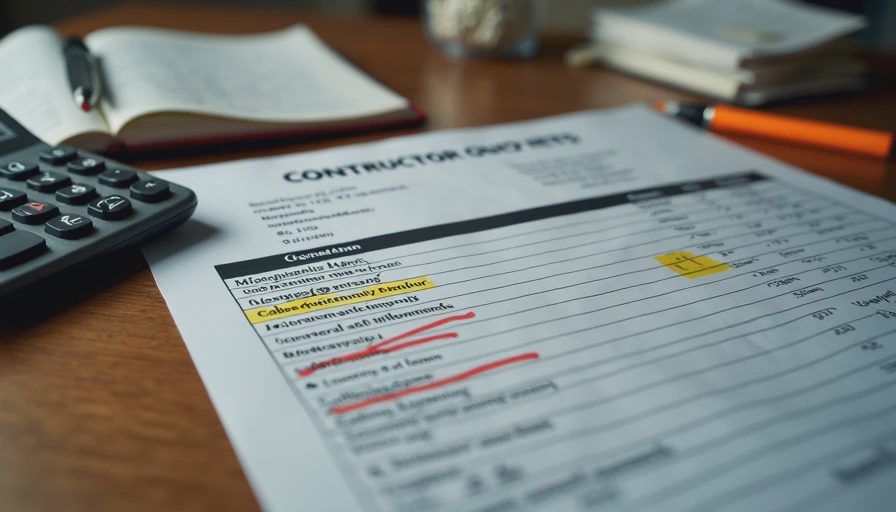
Print the quote. Grab a highlighter and a red pen. Sit down with your spouse or a trusted friend. Go through every line out loud. If you can’t explain what something means, ask the contractor to explain it in writing.
The goal isn’t to become a construction expert. The goal is to stop feeling intimidated and start making informed decisions.
I still get nervous when big quotes come in. But now I have a system. And that system has saved me thousands of dollars across three houses.
You don’t need to know construction terms. You just need to know how to read what they’re actually selling you.
Don’t worry, it’s not expensive to ask questions. But it gets very expensive not to.




No letters yet — pray write the first.